
Blog
RRMSH
October 5, 2026
Is Epidural Delivery Safe for Mother and Baby? Benefits and Risks Explained
The pain in childbirth is one of the major concerns for a lot of expecting mothers. It is very likely that you already know about the epidural by your gynecologist or other people. There are women who speak positively about epidural delivery safety and some who fear it. With these facts, you can talk to your doctor with confidence.
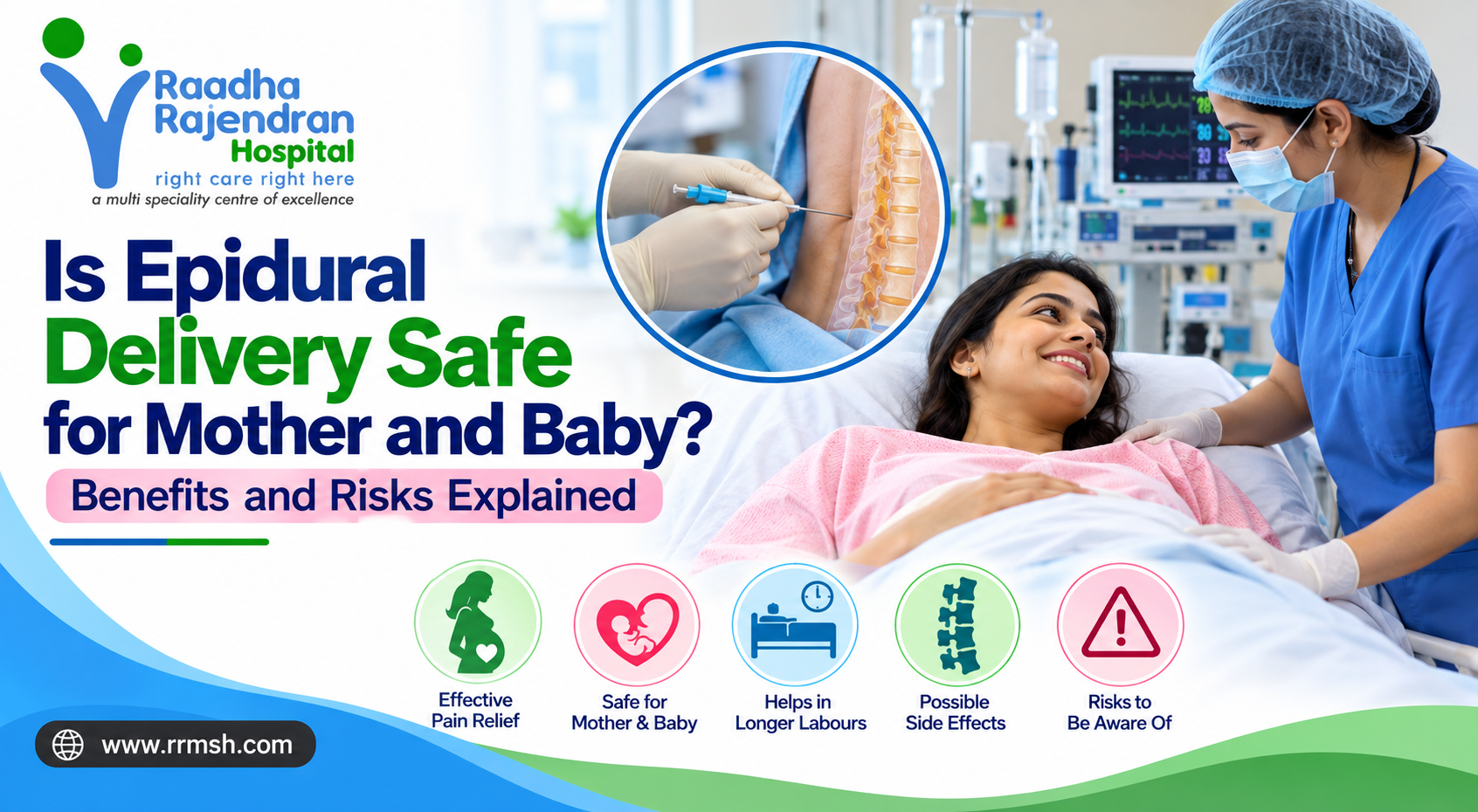
What Is an Epidural?
An epidural is a form of pain relief given during labour. A trained doctor places a thin, soft tube in your lower back. The tube sits near the nerves that carry pain from your womb. Pain medicine flows through the tube and blocks those signals.
You stay awake the whole time and still feel pressure as labour moves forward, but the sharp pain fades. This is why many people link an epidural with painless delivery. Many women say it helps them rest and enjoy the birth.
How Is an Epidural Given During Labour?
Knowing the steps can ease your mind. The whole process takes about 10 to 15 minutes. Here is what happens:
- You get a drip in your arm to give you fluids.
- You sit up or lie on your side and curl your back.
- The doctor cleans your back and numbs the skin with a small shot.
- A thin needle goes in, and a soft tube passes through it.
- The needle comes out, and the tube stays taped to your back.
Pain relief starts in 10 to 20 minutes. The nurse checks your blood pressure, pulse, and your baby’s heartbeat during this time. If pain returns, the doctor adds more medicine through the same tube. So an epidural during labour does not mean you must lie still. You can often change position with help.
Is Epidural Delivery Safe?
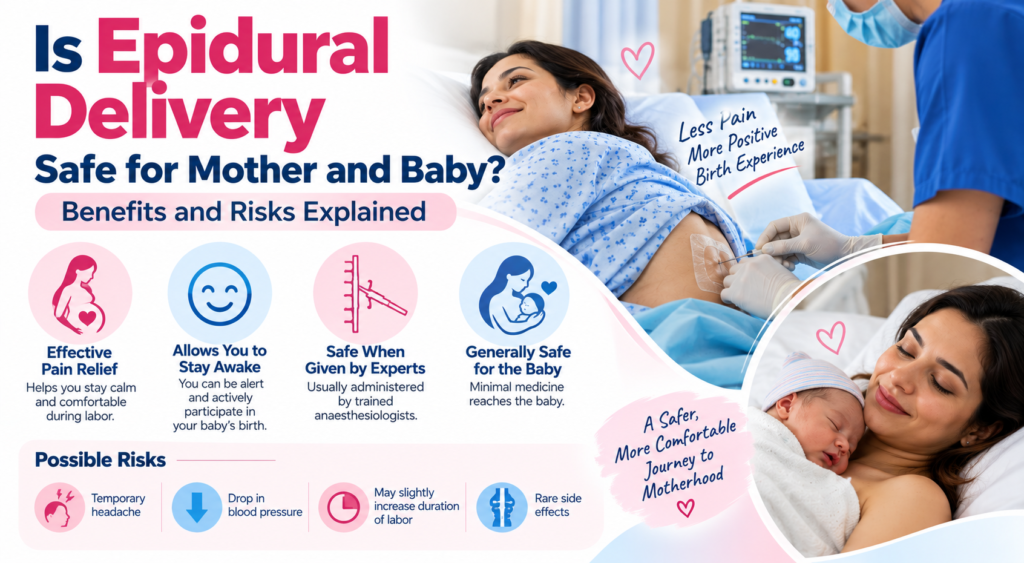
Safety is the first question most mothers ask, and the answer is yes for most healthy women. Epidural delivery safety has been studied for many years. Doctors use epidurals every day in hospitals everywhere. The medicine stays mostly near the spinal nerves, so only a small amount reaches your baby. Research shows no harm to a baby’s health when the epidural is given the right way.
No medical step is free of risk, though. Epidural delivery safety rests on four things: a skilled doctor, the right dose, good timing, and close watch by the labour team. When all four are in place, the chance of a serious problem stays low.
Benefits of an Epidural During Labour
Now look at what you gain. The benefits are clear, and you often feel them within minutes.
- Strong pain relief: Most women feel far less pain soon after the medicine starts.
- Rest and energy: A long labour is tiring, and pain relief lets you save strength for pushing.
- A calm mind: Less pain often brings less fear and stress.
- Backup for a change of plan: If you need forceps or a C-section, the tube already in place can carry stronger medicine.
- Awake and aware: You stay awake and ready to welcome your baby at birth.
Epidural Side Effects You Should Know
Every treatment has a cost. Most epidural side effects are mild and fade on their own.
- Low blood pressure: This can cause dizziness, and the team treats it with fluids or medicine.
- Itching: Some pain medicines cause itching on the face or body.
- Shivering or mild fever: The team checks the cause and treats it.
- Heavy or numb legs: This feeling fades after the medicine stops.
- Trouble passing urine: You may need a small tube for a short time.
- Sore back: The needle spot may hurt for a few days.
- A longer pushing stage: This can raise the chance of forceps or a vacuum a little.
Epidural Risks: Rare but Serious Problems
Serious epidural risks are rare, but you should know them. Your doctor explains them before you sign consent.
- Bad headache: This can follow if the needle goes slightly deeper than planned. Doctors can treat it.
- Infection or bleeding: Both are very rare, and clean steps keep the risk low.
- Nerve injury: Lasting nerve damage is very rare.
- Medicine spreading too high: This can cause low blood pressure or breathing trouble, so the team watches closely.
- Allergy: A reaction to the medicine can happen, but it is rare.
Your doctor may also check blood tests, such as your platelet count, before the epidural. These checks add to your safety.
How Does an Epidural Affect the Baby?
Many mothers then ask about the baby. Most babies are born healthy after an epidural. The team tracks the heartbeat all through labour. If your blood pressure drops, the baby’s heart rate may dip for a short while, and the team fixes this fast. An epidural also does not stop breastfeeding. Start early with help from the nurse, and most mothers feed well.
Who May Not Be Able to Have an Epidural?
An epidural does not suit every mother. Your doctor may advise against it if you have:
- A bleeding problem or a very low platelet count
- Recent use of blood-thinning medicine
- An infection on your back or a serious infection in the body
- Very low blood pressure or heavy bleeding
- A spine problem or past back surgery, which the doctor reviews case by case
- An allergy to the medicines used
Telling your doctor your full health history is key to epidural delivery safety.
Tips for a Safe Epidural
A little planning makes the process smoother. These steps help you and your team.
- Talk to your doctor during pregnancy visits, not only when labour starts.
- Share your allergies, medicines, and past health problems.
- Ask about benefits, risks, and what to expect.
- Pick a hospital with a skilled pain relief doctor and a trained maternity team on duty day and night. This boosts epidural delivery safety.
- Stay still while the needle goes in.
- Tell the nurse if you feel dizzy or itchy, or if one side still hurts.
Painless Delivery Care at RRMSH, Chennai
At RRMSH (Radha Rajendran Multispeciality Hospital) in Alandur, Chennai, our women’s care team guides mothers through each stage of pregnancy. We offer painless normal delivery with round-the-clock maternity and ICU support. More than 30,000 babies have been born here since 1980. Our team explains each choice, so you decide with calm and confidence.
Final Words
An epidural can make labour calmer and far less painful. For healthy mothers, epidural delivery safety is strong when a skilled team gives the right dose at the right time. Side effects are mild in most cases, and serious problems are rare. Speak with your doctor early, ask your questions, and choose what feels right for you and your baby.
 Visit RRMSH today and take the first step toward better health and wellness
FAQs:
Yes, in most cases. Only a small amount of medicine reaches the baby, and the team checks the heartbeat all through labour.
You feel a small sting from the skin shot, then some pressure in your back. Most women find it easier than they feared.
No. Women with bleeding problems or a back infection may not be able to. Your doctor checks this first.
Studies do not show a higher C-section rate. It may make the pushing stage a little longer.
It lasts as long as the tube stays in and medicine is given. The numbness fades a few hours after the medicine stops.
Your legs may feel weak at first. Wait until the nurse checks you and helps you stand.